
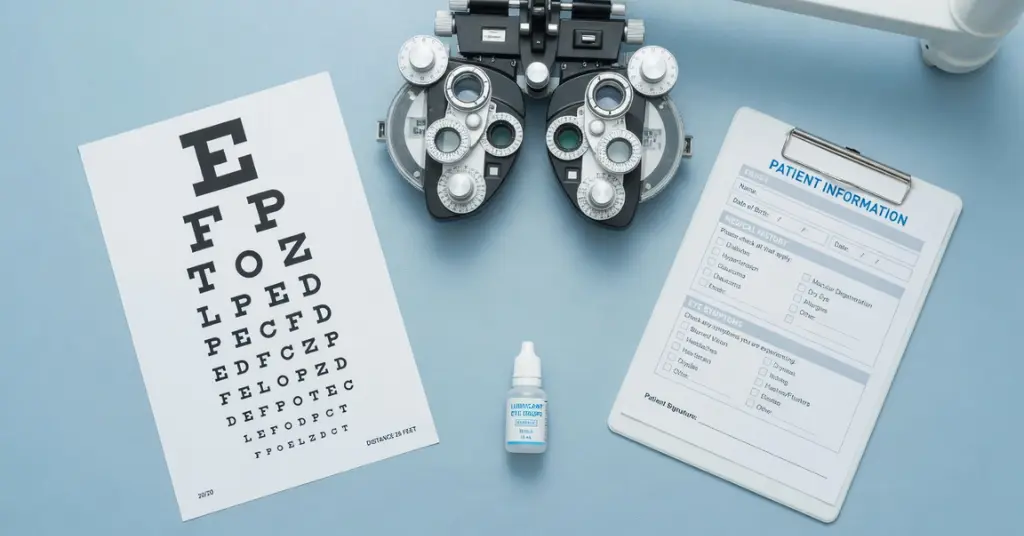
Most people think of an eye exam as the moment you read letters off a chart until they go blurry. That’s part of it — but a comprehensive eye exam is far more than a vision check. It’s a full health checkup for your eyes, and often an early warning system for the rest of your body too.
If it’s been a while since your last visit, or you’re booking your first one, here’s exactly what a comprehensive eye exam involves, why it matters more than a quick vision screening, and how to walk in prepared.
Comprehensive Eye Exam vs. a Basic Vision Screening
It’s easy to assume that “passing” a vision screening means your eyes are healthy. They’re not the same thing.
A basic vision test — the kind you might get at the DMV, a school screening, or even some online “eye exams” — usually only checks how clearly you see at a distance. That’s useful, but it tells you nothing about the health of your eyes or how they focus up close and work together. Plenty of serious eye conditions develop with no symptoms at all, which means a screening can give you a false sense of security while a real problem goes undetected.
A comprehensive eye exam is the complete picture. Only an optometrist or ophthalmologist can perform one, using specialized equipment to evaluate both your vision and the internal health of your eyes. It’s the difference between a single blood-pressure reading and a full physical — one is a quick snapshot, the other actually confirms whether everything is working as it should.
Why Regular Eye Exams Matter
Here’s the part most people don’t realize: your eyes are a window into your overall health. A routine eye exam can pick up the early signs of conditions far beyond your vision — including diabetes, high blood pressure, and many other systemic issues — sometimes before any other symptom appears.
On the eye-health side, conditions like glaucoma, macular degeneration, and diabetic eye disease often progress silently. By the time you’d notice a change yourself, damage may already be done. Catching them early through regular eye exams is the single best way to protect your long-term vision.
How Often Should You Get an Eye Exam?
The right schedule depends on your age and risk factors, but as a general guide for adults:
- Ages 18–39: At least every two years if you’re low-risk; yearly if you’re at higher risk.
- Ages 40–64: At least every two years; annually if recommended.
- Ages 65 and up: Every year.
You fall into the higher-risk group — and should likely book an annual comprehensive eye exam — if you wear contact lenses, have diabetes or a family history of eye disease, take medications with eye-related side effects, or have had eye surgery or an injury. Contact lens wearers in particular benefit from yearly checkups, since lenses sit directly on the eye and need ongoing monitoring.
How to Prepare for Your Eye Exam
A little preparation makes the visit smoother, especially if you’re seeing a new eye doctor. Before you go, gather:
- A list of any current medications, including eye drops, vitamins, and supplements
- Your personal and family medical history (especially any history of glaucoma, cataracts, or macular degeneration)
- Your current glasses and any contact lenses you wear
- A note of any vision changes or symptoms you’ve noticed
- Your vision or medical insurance information
- Any questions you want to ask
A couple of practical tips: it’s worth asking ahead whether your exam will include pupil dilation, since the drops can leave your vision blurry and light-sensitive for a few hours — you may want someone to drive you home, and a pair of sunglasses for afterward never hurts. Try to rest your eyes beforehand too; a good night’s sleep and a break from screens means your eyes are in their best shape for testing.
What Happens During a Comprehensive Eye Exam
A full exam usually takes between 30 and 90 minutes, though each individual test only lasts a few minutes. None of them hurt. The exact mix of tests varies based on your age, history, and any symptoms, but here’s what you can generally expect.
Patient History
Your doctor starts by talking with you — about your eye and vision symptoms, your general health, your job and daily habits, and your family’s eye history. It might feel like a lot of questions, but your eyes are tied to your whole-body health, so these details genuinely shape the rest of the exam.
Visual Acuity Test
This is the classic chart test. You’ll read progressively smaller rows of letters on a Snellen chart from 20 feet away. The result is written as a fraction like 20/20 or 20/40 — the top number is the testing distance, and the bottom number reflects the smallest line you could read clearly. You may also do a near-vision version with a small handheld card.
Refraction Test
If you need vision correction, this is the test that nails down your exact prescription. Looking through a device called a phoropter, you’ll compare lens after lens while the doctor asks which looks sharper — “one or two?” — until they zero in on your ideal correction. Sometimes an autorefractor is used first to get a quick starting estimate.
Pupillary Response and Eye Movement Tests
The doctor shines a small light into each eye to check how your pupils react, then has you follow a pen or light with your eyes to assess the muscles that control movement and alignment. A cover test — briefly covering one eye at a time — helps spot misalignment or conditions like strabismus, where the eyes don’t point in the same direction.
Depth Perception and Visual Field Tests
Depth perception is checked using 3D-style images, while a visual field test maps your peripheral (side) vision. The simplest version just asks you to spot the doctor’s fingers or a moving object at the edges of your sight. Gaps in your peripheral vision can be an early flag for glaucoma or other conditions.
Color Vision Test
Using images made of colored dots (the Ishihara test), this checks for color vision deficiencies. It’s useful even for adults, since a deficiency that appears later in life can occasionally point to an underlying issue.
Tonometry (Eye Pressure)
This measures the pressure inside your eye — a key screening for glaucoma, which almost never has symptoms. It’s done either with the familiar “puff of air” or by gently touching a small instrument to the numbed surface of your eye.
Slit-Lamp and Retinal Exam
Finally, the doctor uses a slit lamp — a microscope with a bright light — to examine the front structures of your eye (eyelids, cornea, iris, lens) for things like cataracts or corneal issues. With an added lens, or after dilating your pupils, they then look at the back of your eye: the retina, optic nerve, and blood vessels. This fundus exam is essential for catching retinal detachment, macular degeneration, and damage from diabetes or high blood pressure.
If You Wear (or Want) Contact Lenses
Planning to wear contacts? Your exam will include a few extra steps. The doctor measures the curvature of your cornea (keratometry) and may check your pupil and iris size to find lenses that fit properly. A tear-film evaluation can also flag whether you’re prone to dry eyes, which affects which lenses suit you best.
Keep in mind that a contact lens fitting is usually a separate service from the standard exam, and a glasses prescription isn’t the same as a contact lens prescription. If you order contacts online, you’ll want a current, valid contact lens prescription in hand — and understanding what OD and OS mean on your prescription is a great place to start before you order.
After the Exam
When everything’s done, your doctor walks you through the results, answers your questions, and lets you know when to come back. If you need vision correction, you’ll receive a copy of your prescription — you’re entitled to it, and it’s handy to keep for ordering glasses or contacts later. Just keep in mind that prescriptions don’t last forever — find out how long your contact lens prescription is good for so you know when it’s time to book again.
Conclusion
A comprehensive eye exam is one of the simplest, most valuable things you can do for both your vision and your overall health. It’s painless, it’s quick, and it can catch problems long before you’d ever notice them yourself. If you can’t remember your last full exam — or you’ve been relying on quick screenings — it’s worth booking one. And once you have your fresh prescription in hand, ordering your next pair of contacts is the easy part.
Frequently Asked Questions
How long does a comprehensive eye exam take?
Most exams take between 30 and 90 minutes. Individual tests only last a few minutes each, but a first-time or more detailed exam may run longer.
What’s the difference between an eye exam and a vision screening?
A vision screening (like at the DMV or school) usually only checks distance vision. A comprehensive eye exam evaluates your full vision and the internal health of your eyes, and can only be done by an optometrist or ophthalmologist.
Does a comprehensive eye exam include a contact lens prescription?
Not automatically. A contact lens fitting is typically a separate service, and a contact lens prescription differs from a glasses prescription. Let your eye doctor know if you want to wear contacts.
How often should adults get an eye exam?
Most adults should have one every one to two years, depending on age and risk factors. Anyone over 65, or with conditions like diabetes or a family history of eye disease, should generally go yearly.
Will my eyes be dilated during the exam?
Often, yes. Dilation gives the doctor a better view of the back of your eye. The drops can blur your vision and increase light sensitivity for a few hours, so plan accordingly.

