
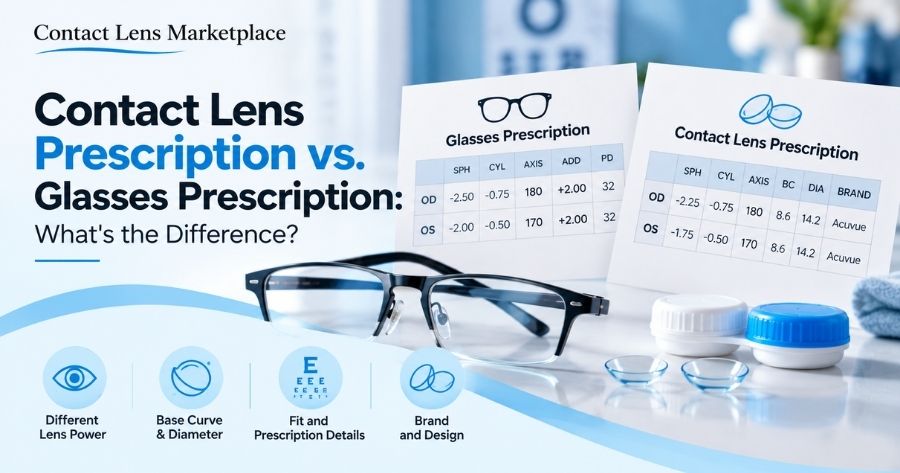
Do you wonder why your contacts show different numbers than your glasses? There are two reasons. Contacts are directly placed on your cornea, which changes the power you need. Contacts must fit the shape of your eye. This means the prescription mentions the base curve, diameter, and brand.
Is a Contact Prescription the Same as Glasses?
No. Do not make the mistake of buying contact lenses based on your glasses prescription. Contact lens prescription vs. glasses is a big debate.
A glasses prescription lists the power for a lens sitting about 12 to 14 millimeters from your eye. A contact lens prescription lists the power for a lens on your cornea, plus base curve, diameter, and a lens brand.
Residents of the United States must follow the FTC Contact Lens Rule. It requires a valid contact lens prescription to buy contacts. You get this prescription after a contact lens fitting, and this is a step beyond a standard glasses exam.
Contact Lens Prescription vs Glasses Prescription
| Field | Glasses prescription | Contact lens prescription |
| Sphere (SPH) | Yes | Yes, adjusted for vertex distance above 4.00 D |
| Cylinder (CYL) | Yes, for astigmatism | Yes, for toric lenses, in limited steps |
| Axis | Yes, any degree from 1 to 180 | Yes, often in 10-degree steps |
| Add power (ADD) | Yes, for bifocals and progressives | Yes, often written as Low, Mid, or High |
| Prism | Yes, when needed | Rarely |
| Pupillary distance (PD) | Sometimes listed | No |
| Base curve (BC) | No | Yes |
| Diameter (DIA) | No | Yes, when appropriate |
| Brand or manufacturer | No | Yes |
| Expiration | Set by state law, often one to two years | At least one year under federal rule |
Why Is My Contact Prescription Different From My Glasses?
The answer comes down to three paramount factors: vertex distance, lens fit, and lens design. Let’s study them one by one.
Vertex Distance Changes Your Power
Vertex distance is the gap between the back of your eyeglass lens and the front of your cornea. Most glasses are approximately 12 millimeters away. A contact lens has no distance.
Light bends differently across this gap. Eye doctors use vertex compensation to adjust the power for contacts. The adjustment becomes more important with stronger prescriptions, typically around plus or minus 4.00 diopters and above.
Nearsighted wearers need a weaker minus power in contacts. Farsighted wearers need a stronger plus power.
Vertex Distance Contacts Examples at 12 mm
The formula: contact lens power = glasses power ÷ (1 − 0.012 × glasses power).
|
Glasses sphere |
Calculated contact power |
Rounded contact power |
|
−2.00 D |
−1.95 D | −2.00 D |
|
−4.00 D |
−3.82 D |
−3.75 D |
|
−5.00 D |
−4.72 D |
−4.75 D |
|
−6.00 D |
−5.60 D |
−5.50 D |
|
−8.00 D |
−7.30 D |
−7.50 D |
|
+4.00 D |
+4.20 D |
+4.25 D |
| +6.00 D | +6.47 D |
+6.50 D |
Soft lenses come in 0.25 D steps up to about 6.00 D and in 0.50 D steps beyond. This explains why a −8.00 D glasses wearer often lands on −7.50 D in contacts. Your eye doctor sets the final power after checking your vision with trial lenses.
Base Curve and Diameter
Glasses do not have to fit on your cornea, but lenses should. Therefore, the lenses must have a specific shape and size. The base curve measures the curve of the lens back surface in millimeters. Most soft lenses fall between 8.3 and 9.0 mm. A lower number represents a steeper curve.
The diameter measures the lens width from edge to edge. Most soft lenses are between 13.8 and 14.5 mm. The lens needs to cover your cornea and move slightly with each blink.
Tight contact lenses can block oxygen access to your cornea. A lens that is too loose slides around and blurs your vision. Your eye doctor can check the fit with a slit lamp during your evaluation.
Brand of Contact Lens
Your glasses prescription works with any frame and any lens maker. Your contact lens prescription names a specific brand. This is because companies use different materials, water content, and oxygen flow.
The same power in a different brand does not equal the same lens. Always ask your doctor to update the prescription if you want to switch the brand.
Toric Contact Lens Prescription for Astigmatism
Astigmatism means your cornea curves more in one direction than the other. Glasses correct astigmatism with any cylinder value in 0.25 D steps. Soft toric contacts come in fewer options.
Many soft toric brands offer cylinder in steps such as −0.75, −1.25, −1.75, and −2.25 D, with axis in 10-degree steps. A glasses cylinder of −1.50 D becomes −1.25 or −1.75 D in contacts, based on your vision during the trial.
Toric lenses also need to stay oriented on your eye. Brands use high-weight or shaped edges to stop the lens from rotating. Your eye doctor watches the lens settle before finalizing the axis.
Multifocal Contact Lens Prescription vs. Progressive Glasses
Progressive glasses place distance and near zones at different heights in the lens. You have to look down to read. A multifocal contact lens moves with your eye, so the design works differently.
Glasses prescription lists add power as a number such as +2.00. The contact lens prescription often converts this number into Low, Mid, or High, depending on the brand. Some brands also mark one eye as dominant, labeled D, and the other as non-dominant, labeled N.
How to Read a Contact Lens Prescription
Let’s explain how to read a sample contact lens prescription. This is for the right eye:
- PWR or SPH: −4.75
- BC: 8.6
- DIA: 14.2
- Brand: Acuvue Oasys
- Expiration: one year from the issue date
A contact lens prescription should mention your name, exam date, issue date, and expiration date. It also highlights the prescriber’s contact details. The prescription must also list the lens power, manufacturer, base curve, and diameter when appropriate.
OD refers to your right eye. OS refers to your left eye. Check the values carefully because eyes may also have different requirements.
Online Calculators to Convert Glasses Prescription to Contacts
Numerous companies have developed online calculators that apply the vertex formula to your sphere power. However, a calculator does not measure your base curve or diameter.
It cannot check your tear film or your corneal health. It does not evaluate how a lens moves on your eye. A calculator cannot suggest a toric or multifocal design. You can use a calculator to understand your numbers, but you need a proper prescription from an eye doctor.
Contact Lens Fitting Exam
A glasses exam includes a refraction. A contact lens fitting adds multiple steps on top of the refraction:
- The doctor measures your corneal curve with keratometry or corneal mapping.
- They examine your tear film and eyelids with a slit lamp.
- You can try lenses on trial in the office.
- The doctor evaluates the lens movement and your vision.
- Wear the trial lenses for a few days and get a follow-up visit.
The FTC mandates that your prescriber share a copy of your contact lens prescription. The same rule applies to your glasses prescription after a refraction.
How Long Does a Contact Lens Prescription Last?
A contact lens prescription stays valid for at least one year under federal rules. A prescriber will mention a shorter date only for a documented medical reason. State law is applicable if the state law sets a longer period.
Glasses prescriptions follow state law, and they are usually valid for one or two years. Contact lenses are classified among medical devices under the FDA. Regular eye evaluations help your doctor check for eye health problems and changes in lens fit.
Never Buy Contacts With Glasses Prescription!
U.S. contact lens sellers must have a valid prescription or verify your contact lens prescription before delivering your lenses. The seller either gets a copy of your prescription or contacts your prescriber.
A glasses prescription does not mention the base curve, diameter, and brand, so the seller cannot verify it. Ask your eye doctor for a contact lens fitting first.
Are you still stuck between the two options? Compare contacts vs. glasses in terms of vision and your convenience.
Frequently Asked Questions
Is my glasses prescription enough to buy contact lenses?
No. Contact lens sellers in the United States must verify a valid contact lens prescription. A glasses prescription does not mention the base curve, diameter, and the brand. Ask for a contact lens fitting from an optometrist or ophthalmologist.
Why is my contact lens power less than my glasses power?
Glasses are 12 millimeters in front of your eyes, and contacts are directly on your cornea. This gap weakens the lens power for nearsighted prescriptions stronger than −4.00 D.
Does a contact lens prescription work for glasses?
No. A contact lens prescription does not include the pupillary distance and prism, and the power reflects zero vertex distance. Glasses made from contact lens numbers give blurry vision for higher powers. Ask your eye doctor for both prescriptions after your exam.
Do I need a new fitting to switch contact lens brands?
Yes. Your contact lens prescription names a specific brand and material. Each brand fits differently, even with the same power and base curve. Your eye doctor needs to check the new lens in your eye and update your prescription.
Do contact lens prescriptions expire sooner than glasses prescriptions?
Often, yes. Federal rules set a minimum of one year for contact lens prescriptions, and many prescribers use one year. Glasses prescriptions follow state law and often last one to two years.
Does astigmatism change my contact lens prescription?
Yes. Astigmatism requires a toric contact lens with cylinder and axis values. Soft toric lenses come in fewer cylinder and axis options than glasses, so your eye doctor picks the closest match after a trial fitting.
Buy Contact Lenses With Your Valid Prescription
In the contact lens prescription vs glasses comparison, each document does a different job. Once you have a current contact lens prescription from your eye doctor, you have everything you need to order.
Shop contact lenses from Acuvue, Alcon, Bausch + Lomb, and CooperVision. Enter your prescription, and our team verifies the details with your prescriber before your lenses ship anywhere in the United States. Contactlensmarketplace.com makes ordering your lenses fast, easy, and reliable.

