
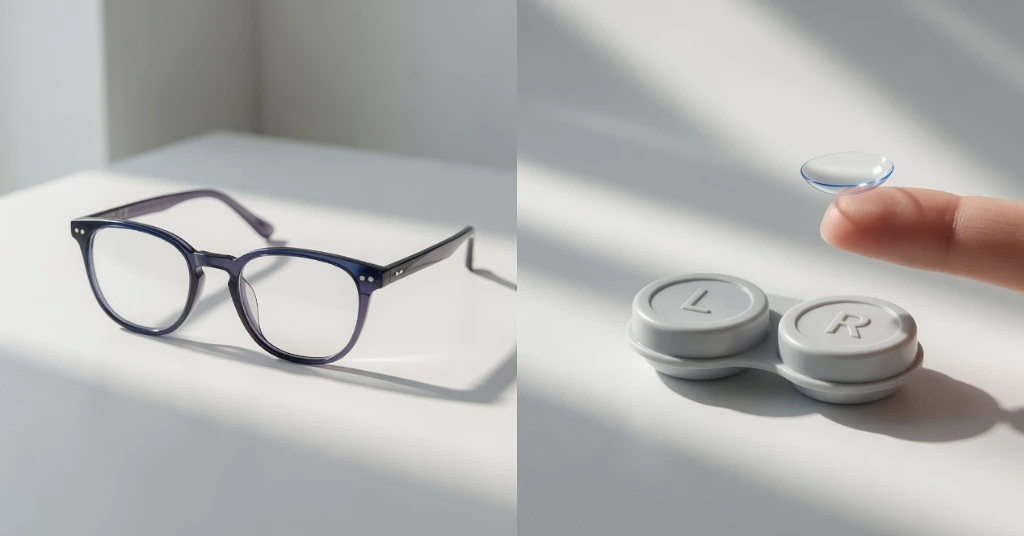
If you need vision correction, one of the first questions you’ll face is whether to reach for glasses, contact lenses, or both. It’s a genuinely personal decision — there’s no single “right” answer. The best choice comes down to your lifestyle, your comfort, your budget, and what feels right to you.
To help you decide with confidence, here’s an honest look at the pros and cons of each, how they actually differ, and why plenty of people end up choosing both.
The Case for Glasses
Glasses are the foundation of vision correction, worn by more than 150 million adults in the US alone. They’re simple, low-maintenance, and double as a style statement.
What’s great about glasses:
- They’re effortless. Put them on and you’re done — no touching your eyes, no daily routine.
- They’re easy to care for. A quick wipe with a microfiber cloth and a protective case is all they need.
- They don’t increase infection risk. Because they never touch your eye, glasses don’t carry the eye-infection risk that comes with contacts.
- Endless style options. Frames can match your personality, your outfit, or your mood — many people build a whole collection.
- Some protection from the elements. Lenses act as a light barrier against wind, dust, and debris.
- They rarely need replacing. Unless your prescription changes, a single pair can last for years.
The trade-offs:
- Limited peripheral vision. Frames don’t cover your full field of view, so your side vision isn’t corrected.
- They can fog, smudge, and scratch. Temperature changes, rain, and everyday wear all take a toll.
- They can feel heavy. Some people dislike the pressure on the nose and ears, especially with stronger prescriptions.
- Not ideal for sports. Glasses can slip, fall, or break during physical activity.
- Strong prescriptions can distort. Very strong lenses may magnify or shrink the look of your eyes, or distort vision at the edges (high-index lenses help reduce this).
The Case for Contact Lenses
Contact lenses sit directly on the surface of your eye and move with it, giving a more natural feel. They’re a favorite for active lifestyles and anyone who prefers their correction to be invisible.
What’s great about contacts:
- More natural vision. Because they move with your eyes, contacts correct your full field of view — including peripheral vision — with no frames in the way and no fogging or rain spots.
- Freedom for sports and activity. They stay put while you run, work out, or dance. (For high-impact sports, protective eyewear is still recommended.)
- They’re invisible. Contacts don’t compete with your face, your makeup, or your style.
- Easy sunglasses. You can wear any off-the-shelf sunglasses without needing a prescription pair.
- Color options. Colored contacts let you subtly enhance or completely change your eye color if you want to.
- Affordable to replace. Losing a disposable lens doesn’t sting your wallet the way losing glasses can.
The trade-offs:
- They require care and discipline. Most lenses need proper cleaning and storage in solution each night — though daily disposables skip this entirely, since you just toss them after one use.
- There’s a learning curve. Putting in and removing contacts takes getting used to, since it involves touching your eye. Most people adapt quickly with practice.
- Infection risk if misused. Poor hygiene or overwearing can lead to dryness, irritation, or infection, so following your eye doctor’s instructions matters.
- Possible dryness. Some wearers experience dryness or irritation, especially during long screen sessions.
- Astigmatism can blur. If lenses rotate, vision may blur briefly — toric lenses are designed to minimize this.
Contacts vs. Glasses: Side by Side
| Feature | Contacts | Glasses |
|---|---|---|
| Field of vision | Natural, full peripheral | Limited to the frames |
| Daily care | Cleaning/storage (or daily disposables) | Quick wipe, minimal |
| Sports & activity | Stay in place | Can slip or break |
| Appearance | Invisible | Visible, style options |
| Infection risk | Higher if misused | Very low |
| Weather | Unaffected | Can fog or get wet |
| Replacement cost | Lower per item | Higher per pair |
Why Not Both?
Here’s the thing most people discover: you don’t actually have to choose. Many wearers keep both and switch depending on the day — contacts for the gym, a night out, or showing off eye makeup, and glasses for relaxing at home, giving their eyes a break, or early mornings and late nights.
In fact, even committed contact wearers should always keep a backup pair of glasses. If you get an eye infection, run out of lenses, or simply need to rest your eyes, glasses are your reliable fallback. Alternating between the two often gives you the best of both worlds.
Are Contact and Glasses Prescriptions the Same?
No — and this is important. A glasses prescription and a contact lens prescription are not interchangeable.
Glasses sit about 12 millimeters in front of your eyes, while contacts sit directly on the eye’s surface. That difference changes the lens power needed, so the numbers won’t always match. If you’re new to reading prescriptions, it helps to first understand what OD, OS, and all those abbreviations actually mean before you place an order.
- Base Curve (BC): how steep or flat the lens curves, so it fits the shape of your eye comfortably.
- Diameter (DIA): the width of the lens across, measured in millimeters.
Your contact prescription will also specify the brand, lens type, and an expiration date. That’s why a contact lens fitting is a separate part of your eye exam — your optometrist matches the lens precisely to your eye’s shape so tears can flow underneath and keep your eye healthy.
If you wear contacts, make sure you order using a current, valid contact lens prescription — never copy the numbers straight from your glasses.
How to Decide
There’s no universal winner here. To figure out what suits you best, think about:
- Your lifestyle — active and sporty leans toward contacts; low-fuss leans toward glasses.
- Your comfort — are you okay touching your eyes, or would you rather not?
- Your routine — daily disposables are great if you want zero maintenance.
- Your budget — factor in how often each needs replacing.
- Your style — glasses can be a fashion statement; contacts keep your face clear.
The single best step is a comprehensive eye exam. Your eye doctor can check your vision and eye health, confirm whether contacts are a good fit for you, and lay out the options — but the final call is always yours. If you’re not sure what to expect, here’s a full breakdown of what happens during a comprehensive eye exam.
So, Which Should You Wear?
Contacts and glasses are both excellent ways to see clearly — neither is objectively “better.” It really does come down to your needs and preferences, and for many people the smartest answer is to have both on hand. Once you know what works for you, browse our full range of contact lenses and place your order in minutes.
Frequently Asked Questions
Are contacts better than glasses?
Neither is universally better. Contacts offer more natural, full-field vision and freedom for activities, while glasses are lower-maintenance and carry no infection risk. The best choice depends on your lifestyle and preference.
Can I wear both glasses and contacts?
Yes, and many people do. It’s smart to keep a backup pair of glasses even if you mostly wear contacts — for eye infections, days off, or giving your eyes a rest.
Is my glasses prescription the same as my contact lens prescription?
No. Contacts sit directly on your eye, so the power can differ, and a contact prescription adds base curve (BC) and diameter (DIA) measurements that glasses don’t include.
Are contacts harder to get used to than glasses?
Contacts have a short learning curve since they involve touching your eye, but most people adapt quickly. Glasses require no adjustment period at all.
Do contacts increase the risk of eye infections?
They can if not used properly. Following good hygiene, replacing lenses on schedule, and not overwearing them keeps the risk low — daily disposables carry the lowest risk since you use a fresh pair each day.

