
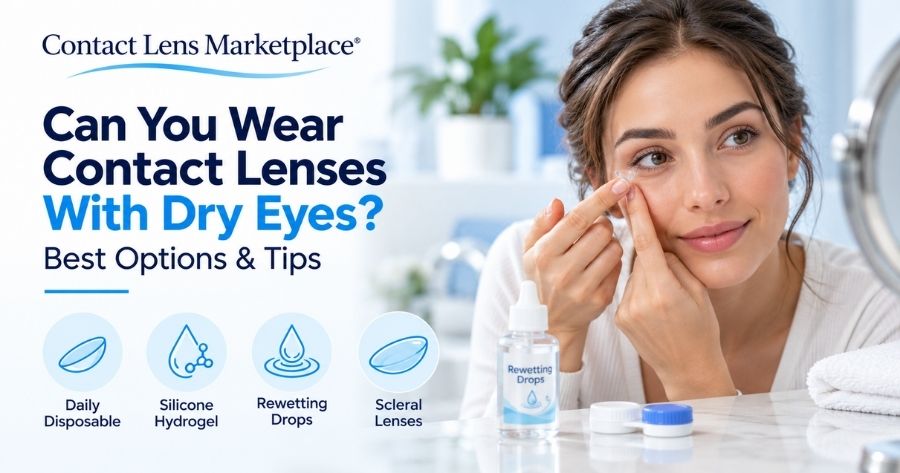
Yes. Most people with dry eyes wear contact lenses comfortably with a suitable lens, its solution, and a few daily habits. Continue reading to find out why contacts dry out your eyes and which options work best.
Quick Overview: Can You Wear Contact Lenses With Dry Eyes?
Yes, for mild to moderate dry eye. Contact lenses for dry eyes use materials and designs to hold moisture and pass more oxygen. The most common options are daily disposable and silicone hydrogel designs. For severe dry eye, eye doctors fit scleral lenses. Have a question about scleral lenses? Our doctors are happy to help. Reach us at youreyesandyou.com.
Dry eyes and contacts often go together. About half of contact lens wearers report dry eye symptoms. Contact lens discomfort also ranks as the main reason people stop wearing contacts. Your eye doctor finds the cause of your dryness first, then picks the lens.
Why Contacts Make Your Eyes Feel Dry
Your tear film has three layers: an oily outer layer, a watery middle layer, and a mucus inner layer. A contact lens splits this film in two. The layer over the lens thins out and evaporates faster.
Four things happen during a day of lens wear:
- Tears evaporate faster: The thin tear layer over the lens breaks up between blinks.
- Lens loses water: Soft lenses can lose water during wear, which may contribute to dryness.
- Deposits build up: Proteins and oils coat the lens and make the surface less wettable.
- Friction increases: A dry lens rubs against your eyelids with each blink.
Most wearers notice dryness late in the day.
Two Types of Dry Eye
Eye doctors separate dry eye into two main types:
- Evaporative dry eye: your tears evaporate too fast. Meibomian gland dysfunction, a blockage of the oil glands in your eyelids, causes most cases.
- Aqueous-deficient dry eye: your eyes make too few tears. Age, hormones, some medications, and autoimmune conditions play a role.
The type matters. A new lens helps both types, but blocked oil glands also need warm compresses and lid care.
Best Contacts for Dry Eyes
Your best lens depends on your tear film, prescription, and routine.
| Lens type | Purpose | Recommended for |
| Daily disposable | Fresh lens each day, no deposit buildup | Most dry eye wearers |
| Silicone hydrogel | More oxygen, holds water better | Long wear days |
| Lower water content | May reduce dehydration in some lens materials | Some dry-eye wearers |
| Scleral lenses | Fluid reservoir bathes the cornea all day | Severe dry eye |
Daily Disposable Lenses for Dry Eyes
Daily lenses start clean every morning. Proteins and oils never build up from day to day. You also skip lens solution, which removes one more possible irritant. Many eye doctors try daily lenses first for dry eye patients.
Silicone Hydrogel Lenses
These lenses let more oxygen reach your cornea than older hydrogel lenses. Many newer versions add wetting agents inside the lens material. These lenses suit wearers with long days at work or school.
Low Water Content Contacts
Water content sounds like a simple rule: more water, more moisture. The opposite often holds true. A high-water hydrogel lens may lose more water during wear. Some lower-water lenses may work better for certain people with dry eyes. Lower-water lenses pull less from your tear film. Most silicone hydrogel materials have lower water content and still pass more oxygen.
Scleral Lenses for Dry Eyes
Scleral lenses are large rigid lenses. They rest on the white of your eye and vault over the cornea. Sterile saline inside the lens creates a fluid reservoir over the cornea during wear. Scleral lenses need a specialty fitting, and eye doctors reserve them for severe dry eye or an irregular cornea. Have a question about scleral lenses? Our doctors are happy to help. Reach us at youreyesandyou.com.
Can Lens Solution Cause Dryness in Your Eyes?
Sometimes the solution causes the dryness, not the lens. Multipurpose solutions contain preservatives. Some eyes react to these preservatives with redness and dryness.
A hydrogen peroxide solution cleans deeply and neutralizes into saline, with no preservatives left on the lens. Always use the case supplied with the product, and never put unneutralized peroxide in your eye. A preservative-free solution is another option. Ask your eye doctor before you switch, since not every contact lens solution suits every lens.
Rewetting Drops for Contacts
These drops add moisture to the lens surface during the day. Use drops labeled for contact lens wear. Standard eye drops and redness-relief drops sometimes cloud lenses or irritate your eyes.
Preservative-free drops are often recommended when you need eye drops more than 4 to 6 times a day. Put drops in before your eyes feel dry, such as midmorning and midafternoon.
Daily Habits to Reduce Dryness in Eyes
Watch Your Screen Time
Screen time and dry eyes go together. You blink less while you focus on a screen, and many blinks stay incomplete. Follow the 20-20-20 rule: every 20 minutes, look at something 20 feet away for 20 seconds. Blink a few times fully during each break.
Care for Your Eyelids
Blocked oil glands thin the oily layer of your tears. A warm compress on closed eyelids for 5 to 10 minutes loosens thick oil in the glands. Your eye doctor recommends lid cleansers if needed.
Change Your Environment
Air conditioning, indoor heating, ceiling fans, car vents, and airplane cabins all speed up tear evaporation. Point vents away from your face. Run a humidifier at home and at work.
Follow Your Wear Schedule
Wear your lenses only for the hours your eye doctor sets. Replace them on schedule. Old lenses collect deposits and lose moisture faster. Remove lenses before sleep, and switch to glasses in the evening on bad days.
Do Omega-3 Supplements Support Eye Health?
Many people take fish oil for dry eyes. A large study funded by the National Eye Institute, the DREAM study, found omega-3 supplements worked no better than an olive oil placebo for dry eye symptoms. Talk with your eye doctor before you spend money on supplements for dry eyes alone.
When to See an Eye Doctor
Mild, late-day dryness responds to the steps above. See an eye doctor if you notice:
- Dryness lasting after you remove your lenses
- Burning or a gritty feeling in the morning before lens wear
- Redness or blurry vision with your lenses in
- Pain or light sensitivity
Pain, discharge, or light sensitivity can point to an eye infection or another eye problem rather than simple dryness.
Your eye doctor tests your tear film, checks your eyelid glands, and treats dry eye syndrome with prescription drops, punctal plugs, or in-office gland treatments when needed.
Frequently Asked Questions
Do contacts cause dry eyes?
Contacts cause dry eye symptoms in many wearers, and they make existing dry eye worse. Lens material, wear time, solution, and screen use all play a role. A lens change and better habits relieve symptoms for many people.
Are daily contacts better for dry eyes than monthly contacts?
Often, yes. Daily lenses start fresh each morning with no deposit buildup and no solution. Some monthly silicone hydrogel options also work well for dry eyes, so your eye doctor decides based on your eyes.
How often should I use rewetting drops with contacts?
Use rewetting drops as directed on the product label or by your eye doctor. Choose preservative-free drops in single-use vials if you need drops more often. Frequent need for drops is a sign to see your eye doctor.
Should I stop wearing contacts if my eyes are dry?
Not always. Many people switch to a better lens or solution and keep wearing contacts. Take a break from lenses if your eyes stay red, painful, or blurry, and see your eye doctor.
Buy Contact Lenses for Dry Eyes Now
Your eye doctor tests your tear film and tells you whether a daily lens, a silicone hydrogel lens, or a scleral lens fits your eyes. Bring that recommendation with you when you shop by brand and lens type at ContactLensMarketplace.com.

