
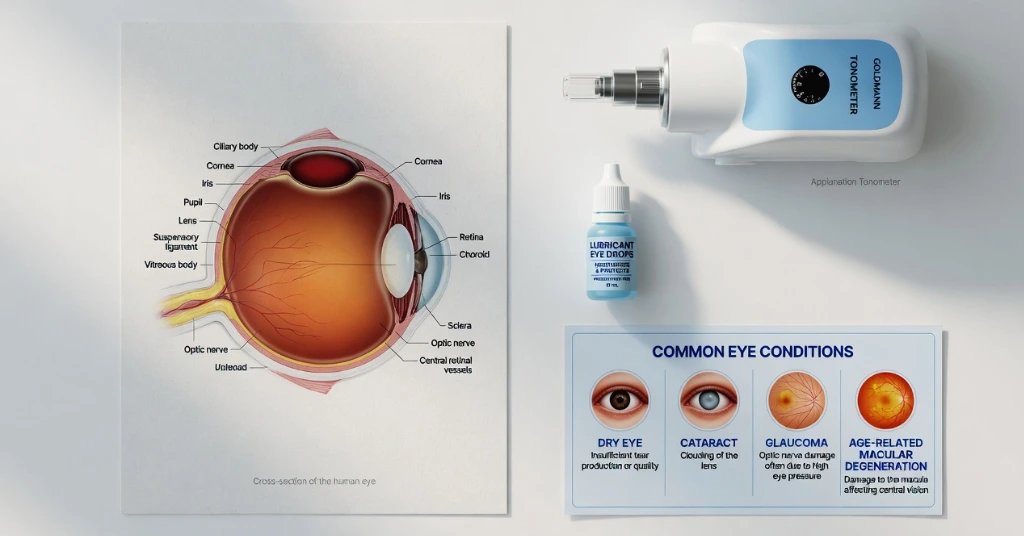
How we see shapes how we understand the world — so it’s only natural to worry the moment something feels off. Blurry vision, redness, sudden floaters, or trouble seeing at night can be unsettling, even when they turn out to be minor. The good news is that most eye diseases are treatable, especially when caught early.
This guide walks through the most common eye conditions and diseases, grouped by the part of the eye they affect, with the symptoms and treatments worth knowing. Think of it as a way to understand what might be going on — not a tool to diagnose yourself. For that, there’s no substitute for an eye doctor.
What Are Eye Diseases?
Eye diseases are conditions that affect any part of your eye or the structures around it — the eyeball itself, but also the eyelids, eye muscles, and the socket. Some are acute, developing quickly and clearing up fast, like many eye infections. Others are chronic, building slowly and lasting for years or even a lifetime.
They’re also remarkably common. The World Health Organization estimates that more than 2.2 billion people worldwide live with some form of vision impairment or blindness. Part of the reason is that your eyes don’t exist in isolation — many eye conditions are tied to the health of the rest of your body, from diabetes to high blood pressure. That connection is exactly why hundreds of different conditions can affect your eyes.
Refractive Errors: The Most Common Eye Conditions
If you wear glasses or contact lenses, you almost certainly have a refractive error. These are the most common eye conditions of all, and they happen when the shape of your eye keeps light from focusing precisely on the retina. The result is blurred vision at certain distances. Your eye doctor records the type and strength of any refractive error on your prescription, and corrective lenses bring your focus back into line.
Nearsightedness (Myopia)
With myopia, distant objects — road signs, a whiteboard, a movie screen — look blurry, while close-up things stay clear. It happens when light focuses just in front of the retina instead of directly on it. Myopia is rising fast worldwide; some estimates suggest about half the global population will be nearsighted by 2050.
Farsightedness (Hyperopia)
Hyperopia is the mirror image: close objects like a book or phone screen are hard to focus on, while distant ones are easier. Here, light focuses behind the retina rather than on it.
Astigmatism
Astigmatism can make objects blurry at any distance. It’s caused by an uneven curve in the cornea or lens, so light bends irregularly instead of focusing on a single point. It often occurs alongside myopia or hyperopia, and is correctable with glasses or contact lenses designed for astigmatism.
Presbyopia
Presbyopia looks a lot like farsightedness but has a different cause: the natural stiffening of the eye’s lens with age. As the lens loses flexibility, focusing on close-up text gets harder — which is why it tends to show up after 40 and why reading glasses, bifocals, or multifocal contacts become helpful.
Glaucoma
Glaucoma is a group of eye diseases that damage the optic nerve, and it’s one of the leading causes of irreversible blindness. Its exact cause isn’t fully understood, but it’s strongly linked to high pressure inside the eye (intraocular pressure). The dangerous part is that glaucoma usually has no early symptoms — vision loss creeps in gradually and can’t be reversed. That’s precisely why a routine eye exam, which includes an eye-pressure check, is so important for catching it early.
Cataracts
A cataract forms when the normally clear lens of your eye turns cloudy, as proteins inside it break down — most often with age. Vision becomes hazy, dull, or dim, and can worsen over time. Cataracts are extremely common in older adults and are one of the most treatable eye conditions, with cataract surgery being a highly effective, routine procedure.
Retinal Eye Disorders
The retina is the light-sensitive layer at the back of your eye that sends images to your brain. Because it’s so central to vision, problems here are among the most serious eye conditions.
Age-Related Macular Degeneration (AMD)
The macula is the part of your retina responsible for sharp, straight-ahead vision. With age, it can thin or become damaged, blurring your central vision and making tasks like reading and driving difficult. AMD is a leading cause of vision loss in older adults.
Diabetic Retinopathy
For people with diabetes, consistently high blood sugar can damage the tiny blood vessels in the retina, causing them to swell, leak, or close off. Left unmanaged, diabetic retinopathy can progress to blindness — but keeping blood sugar and blood pressure in a healthy range significantly lowers the risk.
Retinal Detachment
This is a medical emergency. When the retina pulls away from the back of the eye — usually due to aging or injury — it needs prompt surgical treatment to save vision. Warning signs include sudden flashes of light, a sharp increase in floaters, or a dark “curtain” sliding across your field of view. If that happens, see a doctor immediately.
Corneal Conditions
The cornea is the clear, dome-shaped front of your eye. It’s your eye’s first line of defense and helps focus incoming light.
Keratoconus
In keratoconus, the cornea gradually thins and bulges into a cone shape, distorting how light enters the eye and blurring vision. Milder cases can be managed with glasses or specialty contact lenses, while advanced cases may need surgery.
Eye Movement Disorders
Some conditions affect how the eyes move and align. Despite the nicknames they’ve picked up, they’re not “flaws” — they’re medical conditions, often easier to treat the earlier they’re caught.
Amblyopia (Lazy Eye)
Amblyopia develops in childhood when the nerve pathway between the brain and one eye doesn’t form properly. The brain starts favoring the stronger eye, and the weaker one doesn’t learn to see clearly. It’s far easier to treat in early childhood, which is why children’s eye exams matter so much.
Strabismus (Crossed Eyes)
Strabismus causes the eyes to point in different directions, due to a problem with the eye muscles or the brain’s control of them. Like amblyopia, early treatment gives the best results.
Nystagmus
Nystagmus is an involuntary, rapid movement of the eyes, often side to side. It’s usually neurological in origin, though the exact cause can be difficult to pin down.
Color Blindness
People with color blindness perceive certain colors differently, most commonly struggling to tell red from green. It ranges from mild (so subtle many never notice) to more pronounced. It’s usually inherited and, because the genes involved sit on the X chromosome, it affects far more men than women.
Other Vision Problems
Some issues aren’t standalone diseases but symptoms of an underlying condition:
- Low vision — difficulty seeing clearly enough to affect daily life, which can’t be fully corrected with glasses or contacts. It’s often a sign of conditions like cataracts or AMD.
- Night blindness (nyctalopia) — trouble seeing in low light, making dark rooms or night driving difficult.
- Floaters — small specks or strands drifting through your vision. Usually harmless, but a sudden surge can signal a retinal problem.
What Causes Eye Diseases?
Eye conditions arise from many sources, sometimes overlapping:
- Genetics — inherited conditions like color blindness or a family tendency toward glaucoma.
- Aging — cataracts, presbyopia, and AMD all become more likely over time.
- Other health conditions — diabetes, high blood pressure, and thyroid disease can all affect the eyes.
- Infections — viruses, bacteria, fungi, and parasites can all cause eye disease.
- Environment and injury — UV exposure, airborne particles, and past eye injuries can raise your risk.
- Idiopathic causes — sometimes the cause simply isn’t known.
How Are Eye Diseases Treated?
Treatments vary as widely as the conditions themselves — some help with many problems, others are highly specific. Your eye doctor is always the best source for what’s right for your situation, but here’s a general picture of the main approaches.
- Corrective lenses. For refractive errors — the most common eye conditions — eyeglasses and contact lenses are usually all that’s needed to sharpen vision and bring focus back to the retina.
- Medications. Eye drops and other medicines treat a wide range of conditions, from glaucoma (lowering eye pressure) to infections and inflammation.
- Laser and vision-correction surgery. Procedures like LASIK can reduce or eliminate the need for glasses in some people with refractive errors.
- Surgical procedures. Conditions like cataracts and glaucoma are often treated surgically — cataract surgery, for instance, is one of the most common and successful procedures in medicine.
- Ongoing monitoring. For chronic conditions like AMD or diabetic retinopathy, regular exams and managing your overall health (especially blood sugar and blood pressure) are central to slowing progression.
The earlier a condition is caught, the more treatment options are usually available — another reason regular eye exams matter so much.
How to Protect Your Eye Health
You can’t prevent every eye condition, but you can meaningfully lower your risk and catch problems early:
- Get regular eye exams. Everyone should have a comprehensive eye exam every one to two years — more often if you’re higher-risk. Many serious conditions have no early symptoms, so exams are your best early-warning system.
- Protect your eyes. Wear proper eye protection for sports and hazardous tasks, and sunglasses with UV protection outdoors.
- Don’t smoke. Nicotine harms the blood vessels that supply your eyes.
- Take symptoms seriously. Gradual vision changes warrant an exam, while sudden vision loss, flashes, or a dark curtain are emergencies.
- Eat well and stay healthy. Your overall health — and a diet rich in the right vitamins and minerals — directly supports your eyes.
- Care for your contact lenses. If you wear contacts, follow proper hygiene and wear schedules, since poor lens care raises your risk of infection. Not sure how to get started? Here’s exactly how to order and manage your lenses the right way.
When to See an Eye Doctor
This list is long, but it’s far from complete — and that’s the real takeaway. The smartest move whenever your eyes are bothering you is to see an eye doctor. For most routine concerns and regular checkups, that’s an optometrist; more complex conditions may call for an ophthalmologist.
Even with no symptoms at all, regular visits are one of the best ways to keep your eyes healthy and spot trouble before your vision is at risk. For more tips and guides on maintaining your eye health, explore our eye care resource hub. Take care of your eyes today, and you improve your odds of seeing clearly for years to come.
Frequently Asked Questions
What are the most common eye diseases?
The most common include refractive errors (myopia, hyperopia, astigmatism, presbyopia), cataracts, glaucoma, age-related macular degeneration, and diabetic retinopathy.
Can eye diseases be prevented?
Some can, and the risk of others can be lowered. Regular eye exams, UV protection, not smoking, managing conditions like diabetes, and acting on symptoms early all help protect your vision.
Which eye symptoms are an emergency?
Sudden vision loss, a sharp increase in floaters, flashes of light, or a dark shadow or “curtain” across your vision all need immediate medical attention.
What’s the difference between an optometrist and an ophthalmologist?
An optometrist handles routine eye care, exams, and prescriptions, while an ophthalmologist is a medical doctor who can also perform eye surgery and treat complex conditions.
How often should I get my eyes checked?
Most adults should have a comprehensive eye exam every one to two years, or annually if they’re at higher risk — for example, if they have diabetes, a family history of eye disease, or wear contact lenses.

