
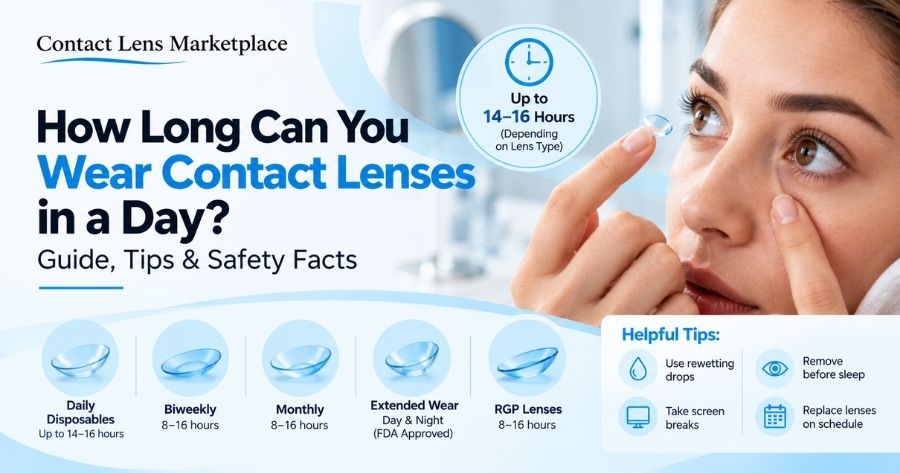
Many people wear contact lenses for several hours a day. The limit depends on your lens type, your tear film, and your daily routine. Wear time has two limits:
- Hours per day: How long each lens stays in your eye before you remove the pair.
- Replacement schedule: How many days pass before you throw the pair away.
Remove every standard lens before sleep. Your eye doctor will set your personal limit at your contact lens fitting and write the replacement schedule on your prescription.
Daily Wear Time by Lens Type
| Lens type | Hours per day | Replacement |
| Daily disposable | Up to 14 to 16 hours | Throw away after one wear |
| Biweekly | 8 to 16 hours | 14 days after opening |
| Monthly | 8 to 16 hours | 30 days after opening |
| Extended wear | Day and night, per FDA approval | 1 to 30 nights, per brand |
| Rigid gas permeable (RGP) | 8 to 16 hours | As your eye doctor directs, often yearly |
| Colored or cosmetic | Same as standard lenses | Per lens type |
Note: These time ranges can vary based on your eye health and the lens type. Confirm with your doctor before wearing the contacts.
Daily Disposable Lenses
Daily contacts wear time ends when you take the lenses out. You throw the pair away, even after 3 hours. Daily lenses are thin and not built for cleaning or reuse.
Biweekly and Monthly Lenses
Biweekly contacts are typically replaced every 14 days. Monthly lenses are typically replaced every 30 days, according to the prescribed replacement schedule. Clean and store both types in fresh disinfecting solution each night.
The monthly contacts replacement schedule starts the day you open the blister pack. Days you skip wearing the lenses still count. A monthly lens opened on March 1 goes in the trash on March 31, even if you wore the pair 10 times.
Extended Wear Lenses
These lenses hold FDA approval for overnight wear. According to the FDA, approvals range from one to six nights up to 30 days of continuous wear. Only your eye doctor decides whether overnight wear suits your eyes.
What Changes Your Daily Limit
Two people with the same lens often reach different limits. These factors explain the gap.
-
Dry Eyes
Dry eyes from contacts shorten comfortable wear time. A lens draws on your tear film to stay moist. When your eyes make fewer tears, the lens dries, and your eyes feel gritty by midafternoon.
-
Screen Time
You blink less while you look at a screen. Fewer blinks mean less tear flow across the lens. Contacts and screen time together explain why many office workers feel dryness late in the day. Follow the 20-20-20 rule: every 20 minutes, look at something 20 feet away for 20 seconds.
-
Your Environment
Air conditioning, indoor heating, airplane cabins, wind, and smoke all dry your lenses faster. Plan shorter wear time on travel days.
-
Medications
Antihistamines, some acne medications, and some blood pressure medications reduce tear production. Tell your eye doctor about every medication you take.
-
Lens Material
Silicone hydrogel lenses pass more oxygen to your cornea than older hydrogel lenses. Higher oxygen transmissibility supports longer, more comfortable wear days for many people.
Contact Lens Break-In Schedule for New Wearers
New wearers need time to adapt. Your eye doctor may recommend gradually increasing your wear time.
| Day | Wear time |
| Day 1 | 4 hours |
| Day 2 | 6 hours |
| Day 3 | 8 hours |
| Day 4 | 10 hours |
| Day 5 onward | Up to 12 hours or your doctor’s limit |
Note: Follow the schedule from your eye doctor if your doctor gives you a different one. Remove your lenses early if you feel pain or see redness.
How Many Hours Should You Wear Contacts on a Long Day?
Wearing contacts for a long day may cause dryness or discomfort. Treat your prescribed wear time as the limit, not a daily goal.
If your day runs from 6 a.m. to midnight, wear your lenses for work and daytime activities. Switch to glasses in the evening. Taking a break from contacts for the last few hours before bed gives your cornea time with full oxygen.
Signs You Wore Your Contacts Too Long
Remove your lenses when you notice:
- Dryness, burning, or a gritty feeling
- Red eyes
- Blurry or hazy vision
- Pain or light sensitivity
- A lens moving more than usual on your eye
Overwearing contact lenses day after day leads to bigger problems:
- Corneal hypoxia: your cornea swells from low oxygen.
- Corneal neovascularization: new blood vessels grow into the cornea to reach oxygen.
- Protein deposits: buildup on the lens blurs vision and irritates your eyelids.
- Contact lens intolerance: your eyes stop tolerating lenses for any length of time.
- Infection: tiny scratches on a stressed cornea let bacteria in.
See an eye doctor the same day for pain, blurred vision, or light sensitivity lasting after lens removal.
What About Sleeping or Napping in Contacts?
Remove standard lenses before any sleep. According to the CDC, sleeping in contact lenses raises the risk of an eye infection six to eight times.
A short nap carries the same risk. A closed eyelid cuts oxygen to your cornea, and the lens traps germs against your eye. The length of the nap does not change the rule.
How to Get More Comfortable Hours
- Use rewetting drops labeled for contact lenses.
- Replace lenses on schedule, even when the pair still feels fine.
- Use a fresh solution every night. Never top off old solutions.
- Keep your lens case clean and replace the case every 3 months or as directed by a professional.
- Drink water and use a humidifier in dry rooms.
- Ask your eye doctor about daily disposable or silicone hydrogel lenses if dryness limits your wear time.
Frequently Asked Questions
Is wearing contacts every day safe?
Yes, for most people. Daily wear is safe when you follow your wearing schedule, remove lenses before sleep, and replace lenses on time. Skip lens wear during an eye infection, redness, or irritation.
Is 16 hours too long for contacts?
Sixteen hours marks the upper limit for most wearers. Some people reach this limit without symptoms. Others feel dryness after 8 hours. Your comfort and your eye doctor’s advice set your personal limit.
What is the 4-to-1 rule for contact lenses?
The informal 4-to-1 rule suggests a 1-hour break for every 4 hours of wear. No clinical guideline sets a fixed break ratio. Breaks help if your eyes feel dry, but your daily total and your replacement schedule matter more.
How long do colored contacts stay in each day?
Colored contacts follow the same limits as standard lenses of the same type. They need a prescription and a fitting in the United States, even with no vision correction.
Is a daily lens reusable the next day?
No. Daily disposable lenses are not built for cleaning or storage. Throw each pair away after one wear, no matter how many hours you wore the lenses.
Before You Put Your Lenses In Tomorrow
Check the date you opened your current pair, and count the hours you plan to wear them. If the pair has passed its replacement date, open a fresh one. Running low? Restock your contact lens supply before your last pair runs out. Contactlensmarketplace.com makes ordering your lenses fast, easy, and reliable.

